By Barr. Kingsley Ononuju
There was a time when the mention of Imo State in labour circles evoked only one image—protests.
Workers marched through the streets demanding salaries they had already earned. Ministries became centres of frustration rather than productivity. Families struggled because the breadwinners had gone for months without pay. Hope gave way to despair.
At one of the darkest periods in our recent history, Imo civil servants were reportedly owed salaries for as long as eight months. The crisis became so severe that the Federal Government had to release bailout funds to assist states in clearing salary arrears. Even then, controversies surrounded the management of those funds, while workers continued to suffer.
Promotion exercises were conducted without financial implementation. Many workers received promotions only on paper. Those fortunate enough to receive salaries often complained that they were not paid their full entitlements. Salary payment was uncertain, irregular and, for thousands of families, heartbreaking.
That was yesterday.
Today, the story of the Imo worker is remarkably different.
Since Governor Hope Uzodinma assumed office, one of the most profound transformations in governance has been the restoration of confidence in the state’s payroll system. Salaries are now paid as and when due. Workers no longer wait endlessly wondering whether the month’s salary will arrive. Timely payment has become government policy rather than political favour.
But Governor Uzodinma did not stop at paying salaries promptly.
He chose to make Imo the highest-paying state government in Nigeria in terms of minimum wage.
In August 2025, the Governor approved a ₦104,000 minimum wage for Imo civil servants—the highest approved by any state government in the federation. The implementation commenced immediately, making Imo the national benchmark for workers’ welfare.
To appreciate the significance of that decision, it is necessary to compare it with what obtains elsewhere.
- Imo State: ₦104,000
- Lagos State: ₦85,000–₦88,000
- Rivers State: ₦85,000
- Akwa Ibom State: ₦80,000
- Bayelsa State: ₦80,000
- Federal Government minimum wage: ₦70,000
These figures speak louder than political arguments.
While many states are still grappling with the implementation of the national minimum wage, Imo has moved substantially ahead, demonstrating that workers’ welfare can be prioritized when there is deliberate fiscal planning.
Nor did the reforms end with the minimum wage.
Recognizing the need to attract and retain highly skilled professionals, Governor Uzodinma approved special salary structures for strategic sectors. Entry-level medical doctors now earn about ₦513,000, while entry-level lecturers receive approximately ₦220,000, reflecting deliberate investment in healthcare and education.
Yet, salaries alone do not define workers’ welfare.
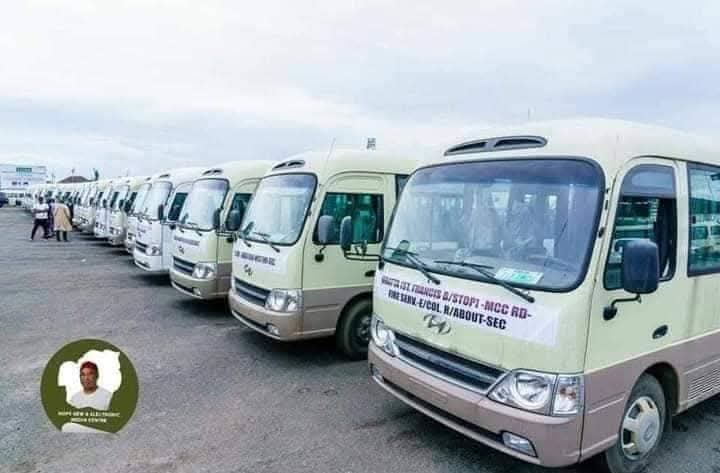
Understanding the economic realities facing civil servants, especially the rising cost of transportation, Governor Uzodinma introduced a free daily bus transportation scheme for workers across the state. Every working day, government-owned buses convey civil servants to and from their places of work at no cost to them, easing one of the biggest financial burdens many workers face.
The significance of this initiative cannot be overstated. At a time when transportation costs continue to rise across the country, many workers spend a sizeable portion of their monthly earnings simply getting to work. By removing that burden, the Imo State Government has effectively increased the disposable income of thousands of civil servants without taking a kobo from their salaries. It is a practical demonstration that workers’ welfare extends beyond what appears on a payslip.
Yet perhaps the most remarkable aspect of this story is what happens every December.
Despite implementing the highest minimum wage among the states, the Uzodinma administration has consistently paid a 13th-month salary to civil servants. What began as an annual gesture has become a tradition of rewarding workers beyond their regular monthly earnings.
This is significant.
Across Nigeria, many governments still struggle to pay ordinary monthly salaries. Some owe arrears running into months. Yet Imo not only pays salaries promptly, it pays the highest state minimum wage, provides free daily transportation for civil servants, improves remuneration for doctors and lecturers, and still rewards workers with an additional month’s salary at the end of the year.
Good governance is measured not only by roads, bridges and physical infrastructure. It is equally measured by how government treats the men and women who keep the machinery of government running every day.
A motivated workforce produces better schools, better hospitals, more efficient ministries and ultimately better governance.
No government is perfect, and constructive criticism remains essential in every democracy. But fairness equally demands that we acknowledge progress where the evidence is overwhelming.
The evidence is clear.
Imo has moved from the era of salary protests to payroll stability.
From eight months of unpaid salaries to one of the most reliable salary payment systems in the country.
From unpaid promotions to improved remuneration.
From labour unrest to the highest state minimum wage in Nigeria.
From expensive daily commuting to free government-sponsored transportation for civil servants.
From uncertainty at Christmas to the assurance of a 13th-month salary.
History has a way of separating rhetoric from results.
When the chapter on workers’ welfare in Imo State is eventually written, one fact will stand beyond dispute: Governor Hope Uzodinma inherited a civil service associated with salary arrears and labour unrest and transformed it into one that today enjoys Nigeria’s highest state minimum wage, prompt salary payments, enhanced salaries for critical professionals, free daily transportation to work, and a consistent 13th-month salary.
For thousands of Imo workers and their families, that is not merely a policy achievement.
It is a restoration of dignity.
For those looking for false reasons to attack Governor Hope Uzodinma, perhaps you’ll use this one as his biggest “offense.”