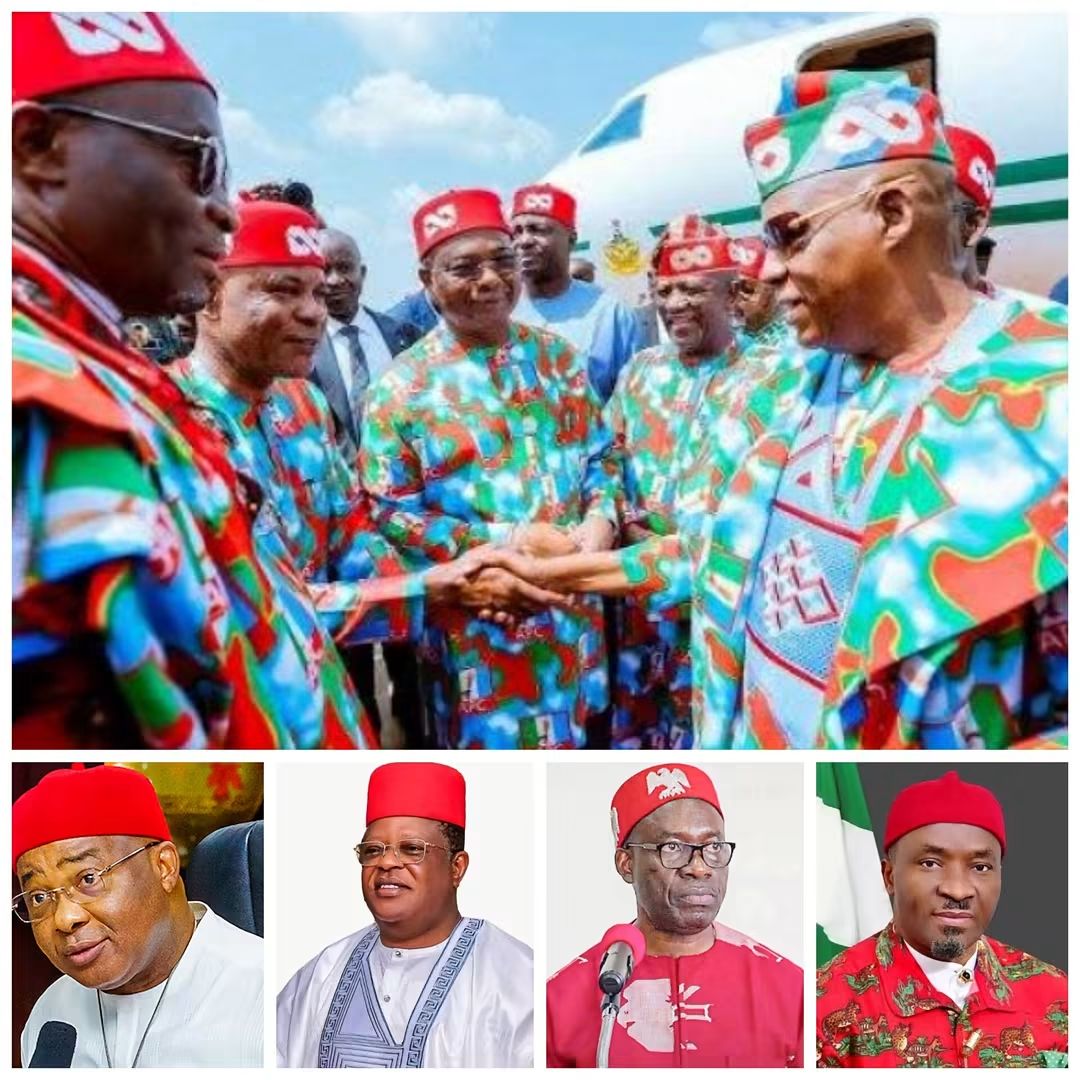
By UUbong Bassey
This may sound harsh, but it is an uncomfortable political observation that deserves serious discussion.
In Nigeria’s political equation, Igbo politicians often appear to play the role of a constant, represented by K in mathematics. Other political blocs determine the direction of the equation, while some South-East politicians willingly position themselves as the variables that can be manipulated to produce somebody else’s desired answer.
The saddest part is that the division is not always imposed from outside. Sometimes, it is sustained by their own political leaders, who seem more interested in competing against one another than building a common political direction for their people.
Since Nigeria’s independence, the South-East has not produced a President of the Federal Republic of Nigeria, either under military or civilian rule. That reality should provoke serious political reflection.
Let’s examine the return of democracy in 1999.
Dr Alex Ekwueme was a prominent political figure and one of the leading voices in the PDP at the time. Yet, the South-East political establishment did not rally behind his presidential ambition. Olusegun Obasanjo eventually emerged and went on to govern Nigeria for eight years, from 1999 to 2007, representing the South-West.
Goodluck Jonathan, from the South-South, governed for approximately six years, from 2010 to 2015.
Now, Bola Tinubu, another South-West politician, has served from 2023 and is seeking another four-year term.
If he completes two terms, the South-West will have occupied the presidency for 16 years since 1999.
Meanwhile, some South-East political leaders are busy opposing Peter Obi and questioning why he should seek the presidency now. Their argument is that it is supposedly not yet the South-East’s turn, and that when their turn eventually comes, they should be allowed to complete eight years rather than settle for four.
But here is the question: How can you get eight years when you are unwilling to fight for the first four?
Nigeria conducts presidential elections every four years. Nobody is constitutionally guaranteed eight years. You must first win the opportunity to serve before discussing a second term.
And if Tinubu completes another four years, power will most likely become a subject of renewed negotiation with the North. Why should anyone assume that the South-South will simply surrender its own presidential ambition when that conversation returns to the South?
The South-South has the human resources, political experience and economic importance to pursue the presidency. So why should the South-East continue behaving as though its political destiny depends on the generosity of other regions?
THE SENATE PRESIDENCY EXPERIENCE IS ANOTHER EXAMPLE.
In 1999, the South-East produced the Senate President, beginning with Evan Enwerem. But what followed was a succession of leadership crises, political disagreements and removals.
The succession was:
- Evan Enwerem (1999)
- Chuba Okadigbo (1999–2000)
- Anyim Pius Anyim (2000–2003)
- Adolphus Wabara (2003–2005)
- Ken Nnamani (2005–2007).
Five Senate Presidents from the South-East in eight years!
Rather than consolidating that opportunity into lasting political influence, internal political battles repeatedly disrupted the arrangement.
Look at the present political environment.
Some South-East politicians appear more occupied with attacking Peter Obi than articulating a common regional political agenda. David Umahi has repeatedly been at odds with Obi politically. Governor Charles Soludo has also publicly criticised Obi on several occasions.
Even the controversy surrounding the removal of a paid campaign poster bearing Obi’s image in Anambra raised questions about political tolerance and the treatment of opposing political interests.
And what about the promises made to the people?
Tinubu’s administration has not released Nnamdi Kanu, despite the expectations and political assurances that many people associated with the administration’s engagement with the South-East. His continued detention and eventual transfer to Sokoto became another major issue in the region’s political conversation.
Yet, some South-East politicians continue to defend the same political establishment while attacking their own regional political alternatives.
This is where the real conversation should begin.
I am not saying every Igbo politician thinks alike, nor am I suggesting that every South-East political leader is against the interests of his people. There are principled individuals across the region.
But regional political unity cannot be built on personal ambition, political appointments, temporary benefits and the crumbs that fall from the tables of those who hold federal power.
MY BIGGEST CONCERN IS THIS:
Why must a politician from the South-East become an enemy of another South-East politician simply because they have different political ambitions?
Why should regional interests always take a back seat whenever personal political opportunities are available?
Why should some leaders be comfortable negotiating for appointments while their region continues to demand greater representation at the highest level of national leadership?
You cannot continuously sacrifice collective political influence for individual political survival and expect a different outcome.
The North understands political bargaining. The South-West understands political consolidation. The South-South has demonstrated its capacity to occupy the presidency.
What, then, is the long-term political strategy of the South-East?
You cannot complain about political marginalisation while repeatedly undermining every opportunity to build collective political influence.
Until the South-East begins to distinguish between personal political ambition and collective regional interest, its politicians will continue to find themselves in other people’s political calculations.
And in that equation, K will remain K!
