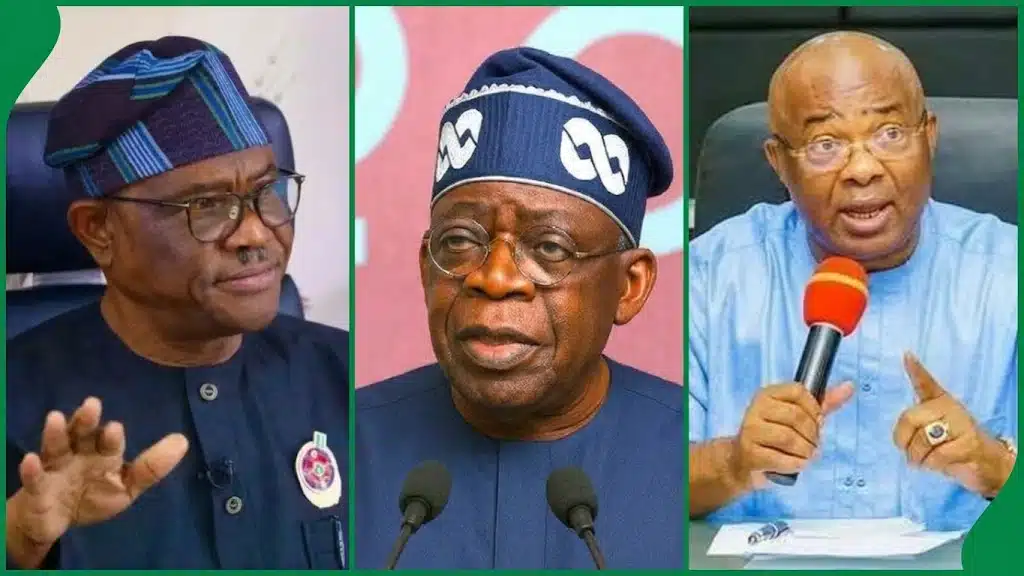
The spokesperson for the All Progressives Congress (APC) Presidential Campaign Council, Ima Niboro, has called on President Bola Tinubu to intervene in the growing disagreement between FCT Minister Nyesom Wike and APC governors over the proposed Rainbow Coalition ahead of the 2027 elections.
Niboro said the dispute, which has increasingly spilled into public exchanges, should be resolved internally before it affects political relationships at the state and local government levels.
Speaking during an appearance on Arise News, Niboro described the disagreement as a “quarrel among political siblings,” noting that both sides have publicly expressed support for Tinubu’s return in 2027, although they disagree over how that support should be organised.
The disagreement centres on Wike’s proposed Rainbow Coalition, a cross-party political arrangement that he says is designed to mobilise support for Tinubu while allowing politicians from different parties to retain their identities and contest other positions.
APC governors, led by Progressive Governors Forum Chairman and Imo State Governor Hope Uzodimma, have rejected the arrangement, saying they would not support any political alliance capable of weakening the APC or affecting the party’s candidates in the 2027 elections.
Wike, however, has maintained that the Rainbow Coalition is not intended to replace or undermine the APC. He has argued that supporting Tinubu for president does not require politicians to abandon their respective parties or prevent those parties from fielding candidates for other offices.
The disagreement became more heated after Wike described some APC governors as “politically lazy” for opposing his initiative. The governors have maintained that their concerns are centred on protecting the APC’s structure and candidates.
Niboro urged both sides to move away from television exchanges and concentrate on building support among voters.
“When I said tone down the rhetoric, I do not mean stop working. Stop talking, go and work,” he said, urging political leaders to engage directly with people in their communities, streets and marketplaces.
He also said the dispute should not necessarily be viewed as a direct challenge to Tinubu, since both camps have indicated that they support his re-election.
“The ultimate beneficiary of this entire process is the President,” Niboro said, adding that the disagreement was beginning to “trickle down to states and local government areas.”
According to him, Tinubu’s political experience could be useful in managing the competing interests.
“The President is an astute, very experienced politician,” Niboro said, arguing that disagreements of this nature can emerge when political parties become large and contain competing interests.
He drew a comparison with the former ruling Peoples Democratic Party (PDP), arguing that internal disagreements eventually contributed to divisions within the party.
“These are the issues that happen when you have big parties. It is inevitable. So they have to be managed,” he said.
Niboro added that he believed Tinubu would be able to manage the competing interests within the emerging political coalition.
“We have a leader who I think is competent enough to manage these things, and he will. Take my word for it,” he said.
The comments come as political alignments ahead of the 2027 general elections continue to generate disagreements over how presidential, governorship and legislative interests can coexist within emerging alliances.
